Skip to content
crm migration
Salesforce CRMPipedrive CRM

Move your Salesforce CRM data into Pipedrive CRM

Your custom fields, your history, your relationships. Not only the fields both apps happen to have in common.

Start free assessment

We run Salesforce CRM to Pipedrive CRM migrations. The assessment is free and comes before any commitment.

Running this for a client? Explore partnership options.

What moves

See where each object lands in Pipedrive CRM.

Salesforce CRM

Accounts
Organizations
Contacts
People
Leads
People so what arrives is a record your team can work
Person Accounts
People
Products
Products
Opportunities
Deals
Tasks
To-do activities
Tasks logged as calls
Call activities
Events
Meeting activities
Salesforce Files
Pipedrive files, on the record they were attached to
Opportunity stages
Matched to the stages your Pipedrive account already has with any stage that has nowhere to go named before the run
An opportunity won or lost
Marked won or lost on the Pipedrive deal itself Pipedrive keeps that on the deal rather than at the end of the funnel
Custom fields
Created as custom fields on the item they belong to
Users
Matched to your Pipedrive users by email and you name who inherits the records of anyone with no match
Links between records
Pipedrive's own links between people, organizations, deals and activities
Start free assessment
What comes across

Keep the data that matters to you.

Keep records connected

Keep deals linked to contacts and companies, and activities linked to their records in Pipedrive CRM.

Your custom fields come with you

We find your custom fields in Salesforce CRM and plan how their values will travel to Pipedrive CRM before migrating their records.

Bring your activity history

Your activity history arrives on the record it belongs to. This page names which types transfer and any limit on them.

Match owners, pipelines and stages

We match them to your Pipedrive CRM users and stages.

Review changes before the run

The plan flags values that change during migration. The original value comes across beside the converted one.

Keep data with no matching field

Where possible, we create a field in Pipedrive CRM for data with no matching field.

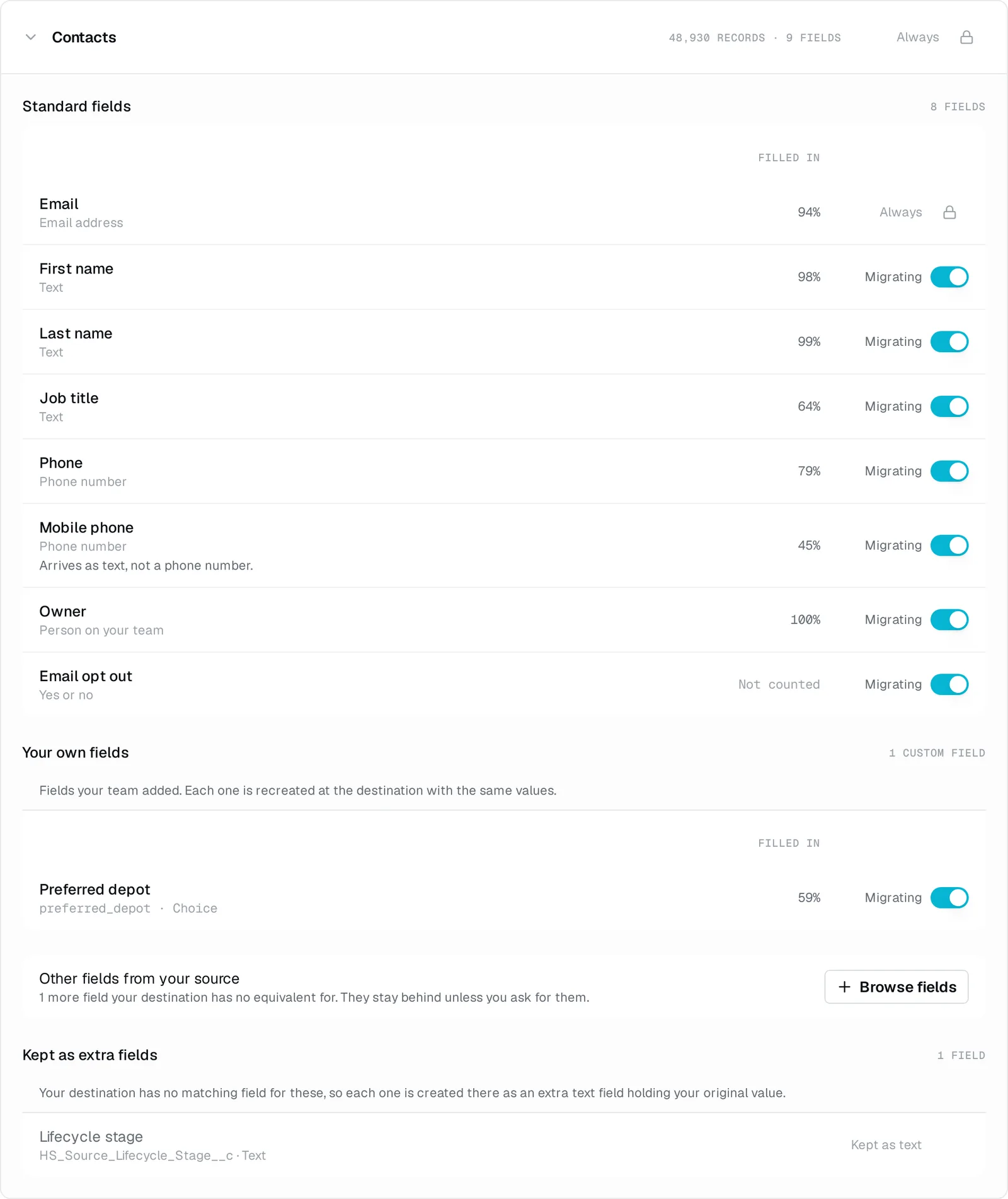
A Contacts plan showing standard fields, a custom field, usage percentages and migration switches.
Demo output. Our HubSpot demo uses synthetic records. This Contacts plan shows custom field usage and which fields will migrate. View at full size.

Demo output from our own system. Synthetic records, not customer data.

Limits and changes

Know what changes and what stays behind.

Each row explains a limit and what you can do about it. Open the details for the reason and supporting source.

Needs setup or a plan change

How many deals your Pipedrive plan will hold is capped

View detailsHide details

Pipedrive counts your active leads and deals against a limit set by your plan, 2,500 per user on Lite, 5,000 per user on Growth and 15,000 for the whole company on Premium. A Salesforce org with more opportunities than your plan holds cannot bring them all across.

Verified against support.pipedrive.com

We count yours first, so you see that before you commit.

Moves with changes

A field that holds a date and a time keeps the date

View detailsHide details

Pipedrive's custom field types are date and time as two separate kinds, with no combined one. So a Salesforce date/time field we create in Pipedrive keeps the day and not the time of day.

Verified against support.pipedrive.com

The assessment names the fields this affects before anything is written.

Stays in the source CRM

Your logged emails stay in Salesforce CRM

View detailsHide details

Pipedrive fills its inbox by syncing a mailbox, and its mail API reads, updates and deletes the messages that arrive there. It publishes nothing that creates one. So a Salesforce email that was sent years ago has no route in.

Verified against developers.pipedrive.com

Your calls, events and tasks come across, and the email stays where it is.

Your Salesforce custom objects have no home in Pipedrive

View detailsHide details

Pipedrive's items are the seven it ships, leads, deals, people, organizations, activities, products and projects, and an account cannot add one of its own. So the records of a Salesforce custom object have nowhere to land.

Verified against support.pipedrive.com

We say which ones that affects during the assessment rather than after the run.

Stay in control

Paused runs resume. You can undo the migration.

Undo the migration

One action removes the records we wrote to Pipedrive CRM. Review what will remain before you undo and retry.

Paused runs resume

A paused run resumes where it stopped, without losing progress or duplicating records.

Read-only in Salesforce CRM

We only read Salesforce CRM. Nothing is written back to it.

Catch up before switching over

Keep working in Salesforce CRM while you check the results. Then bring across the latest changes before switching over.

What undo removes and what remains

In Pipedrive CRM after the migration

The records we wrote
Removed
The history and attachments that came with them
Removed
Except products and price lists, where we brought them across
Left in placeThese may be used in your quotes or reports, so removing them could affect other work.
The custom fields we created
Left in place, emptyWe can remove these separately on request.
What it costs

One payment, based on the records you move.

From $799

Covers up to 20,000 records. Larger migrations use higher tiers. You pay once per migration, with no recurring charge.

Get your exact price for free

Connect Salesforce CRM to see your record count and price before you commit.

A 30-day money-back guarantee

Ask for a refund within 30 days of your migration being marked complete. We reverse the migrated data out of Pipedrive CRM and refund you.

View pricing.

FAQ

Questions about moving Salesforce CRM to Pipedrive CRM

Will my Salesforce custom fields come across?

Yes. The free assessment finds them in Salesforce, and they are created as custom fields on the matching Pipedrive item before records are migrated. Review the plan and choose whether to leave unused fields behind.

What happens to my Leads and Person Accounts?

Both land as Pipedrive people. Accounts become organizations and Opportunities become deals, so the shape of your pipeline comes with you, and a lead arrives as a record your team can work rather than one waiting to be converted.

What happens to my activity history?

Your tasks land as Pipedrive to-dos, a task logged as a call lands as a call activity, and your events land as meetings, each one on the record it belongs to and with its owner and its date. The files on your Salesforce records come across onto the record they were attached to.

What about my Salesforce notes?

They stay in Salesforce. Salesforce keeps notes as files rather than as activities, so we cannot read them the way we read your calls, emails and tasks. This is on your plan before you commit.

What about the line items on my opportunities?

Your product catalogue comes across as Pipedrive products. The lines priced on each opportunity do not yet, and that one is our limit rather than Pipedrive's, so it is on your plan before you pay rather than a surprise after the run.

Do my opportunity stages survive?

Your deals are routed onto the pipelines your Pipedrive account already has rather than into new ones we create, matched by what each stage meant. A stage with nowhere to go is named before the run rather than discovered during it.

Do I have to build a field map?

No. We work out what each value becomes, so nobody builds a field map. You review the plan before the migration runs. A Salesforce field with no native home in Pipedrive can be brought along as a new field instead of being left behind.

Who actually runs the migration?

We run the migration and stay reachable. Connect Salesforce for the free assessment and price, then Pipedrive to complete the plan. Nothing moves until you ask.

Can I keep working in Salesforce while this happens?

Yes. We only read Salesforce and never write back to it. Keep working while you check the results, then bring across the latest changes before switching over.

What if the result is not what I expected?

You can undo the migration, correct the issue and run again. Created fields, shared catalogue data and any other items listed as retained stay in place.

What does it cost?

One payment, based on the records that move. The free assessment of Salesforce gives you the exact count and price before you commit. Payment is by invoice, with no subscription.


Next step

Create an account and connect Salesforce CRM for your free assessment. See your record count and price before you commit. Nothing moves until you ask.

Start free assessment