
Skip to content
crm migration
Close CRMSalesforce CRM

Move your Close CRM data into Salesforce CRM

Your custom fields, your call and email history, your pipelines. Not only the fields both apps happen to have in common.

Start free assessment

We run Close CRM to Salesforce CRM migrations. The assessment is free and comes before any commitment.

What moves

Every object, and where it lands in Salesforce CRM.

Close CRM

Leads
Accounts a Close lead is a company, so it arrives as one
Contacts
Contacts
Opportunities
Opportunities named after the company they sat on, since a Close opportunity has no title of its own
Pipelines and statuses
Matched to the funnel your Salesforce already has with what each status meant, won, lost or still open, carried with it
Notes
Notes on the record they belong to
Tasks
Tasks
Calls
Tasks logged as calls
Emails
Tasks logged as emails
Meetings
Events
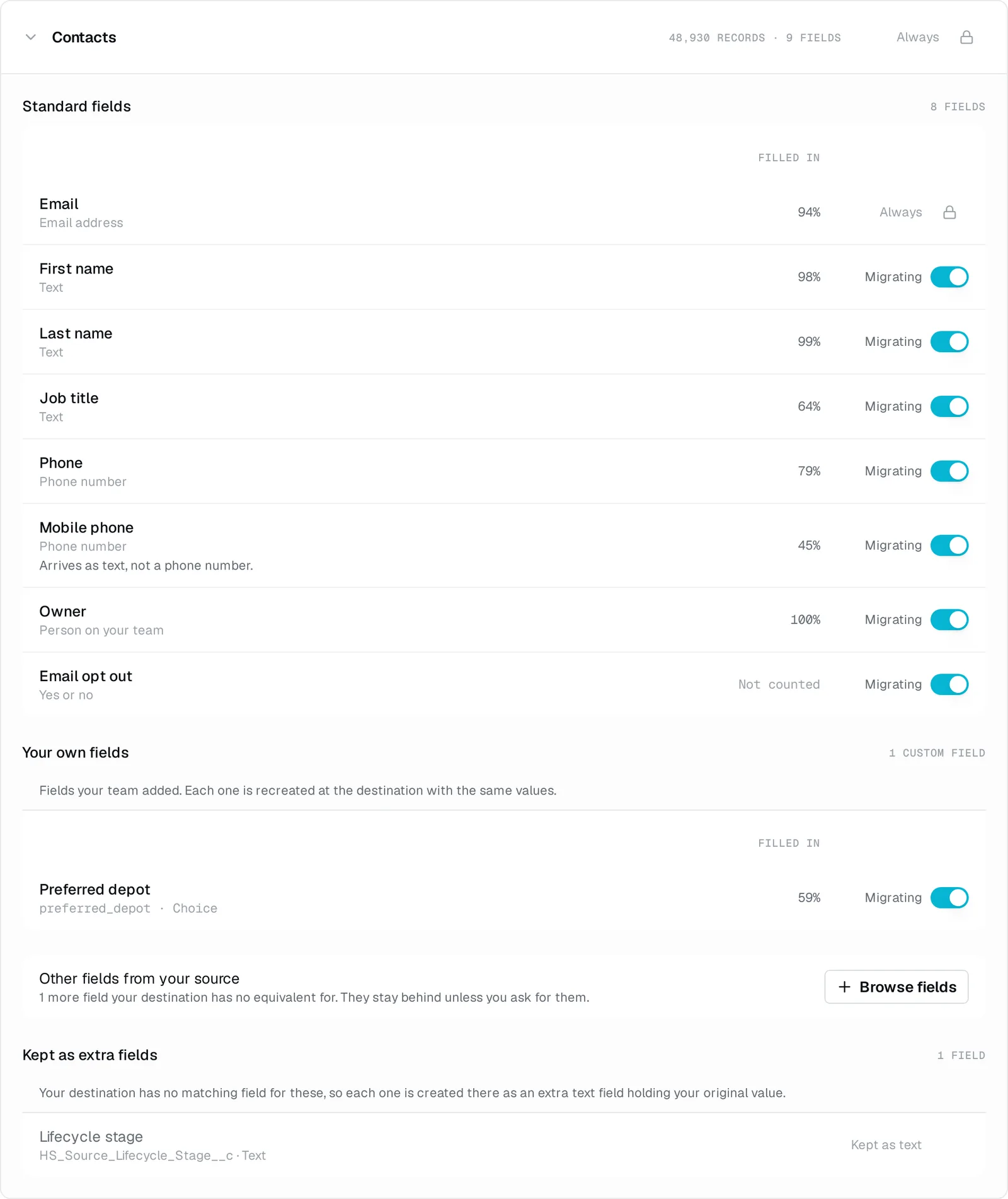
Custom fields
Created as custom fields on the record they belong to
Your Close custom objects
Custom objects, one for each
Users
Matched to your Salesforce users by email and you name who inherits the records of anyone with no match
The lead each record hung off
The link between the company and everything under it
Start free assessment
What comes across

Comprehensive by default, customizable on request.

Relationships, not just records

The graph survives. Deals stay attached to the right contacts and companies, activities stay on the record they belong to, and the links between them are rebuilt in Salesforce CRM rather than left behind.

Your custom fields come with you

They are found in Close CRM and created in Salesforce CRM before a single record is written. Not flattened into a notes field.

History, not just the current state

Notes, calls and meetings arrive on the record they belong to, with their owners and timestamps intact.

Owners, pipelines and stages are reconciled

Matched to your Salesforce CRM users and stages rather than reset to a default.

Nothing is silently rewritten

Where a conversion is genuinely lossy, the original value comes across alongside the converted one, so you can always see what the data was before we touched it.

A field with no home is brought along

If Salesforce CRM has no native place for something you use, we can create one for it rather than drop it.

Before you move

A Close lead is a company, and that is good news on the way out.

Close’s primary record is the lead, which is a company with its contacts, opportunities, tasks and activities hanging off it. Most CRMs are shaped the same way, so this direction is mostly a matter of putting each child under the right parent, and the parentage is what the assessment checks hardest.

What happens to the rest

Where it is not a clean match, here is what happens.

Every one of these says what you get instead, and the detail behind it carries the vendor's own documentation so you can check the claim yourself. You see how each applies to your data in the free assessment, before you commit to anything.

What your plan decides

How many custom fields Salesforce will hold per object depends on your edition

Explain moreHide the detail

Salesforce caps custom fields per object, and the cap moves with your edition. A Close organization that has grown a lot of custom fields can exceed it.

Verified against help.salesforce.com

We count yours in the free assessment and show you the number against your edition's limit, so you can decide what to bring rather than find out during the run.

Comes across, with a difference

Your calls, emails, meetings and tasks share one pool of custom fields

Explain moreHide the detail

Salesforce gives activities one allocation of custom fields shared across tasks and events, up to 300, rather than one each. Your Close calls, emails and meetings all land as Salesforce activities, so the fields you added to any of them draw on that single allowance.

Verified against help.salesforce.com

The free assessment counts them together, which is how Salesforce counts them.

A contact's one name is split on the last space

Explain moreHide the detail

Close keeps a single name on a contact where Salesforce CRM keeps a first and a last, so we split on the last space. That is right for Mary Anne Evans and wrong for Ludwig van der Berg. Close stores one string, so the information needed to do better is not in it.

Verified against developer.close.com

The free assessment shows you the names it affects before you pay.

Stays where it is

Your attachments stay in Close CRM

Explain moreHide the detail

Close does keep files. What it does not document is whether the URL it serves the bytes from can be fetched with an API credential rather than a browser session, and we will not carry bytes we have no confirmed way to read. It is on your plan before you pay rather than a surprise after the run.

Verified against developer.close.com

Your notes, your tasks and your activity history all come with you.

And if it goes wrong

You can undo it in one action. If a migration stops, it resumes where it left off.

Undo the records we wrote

Every write into Salesforce CRM is recorded, so one action takes the records we wrote back out again, in reverse. If it is not what you expected, restore and retry.

Paused, not lost

A stop, an error or an API limit pauses the run at its last checkpoint rather than killing it. Nothing is lost and nothing is written twice.

Read-only in Close CRM

Nothing is ever written back into Close CRM. It is the system you are leaving, and we only read it.

A last catch-up before you switch over

After the main load, one action brings across everything that changed in Close CRM since, so you can verify with both systems live and then switch over.

What an undo takes back out

In Salesforce CRM after the migration

The records we wrote
Removed
The history and attachments that came with them
Removed
Except products and price lists, where we brought them across
Left in placeYou may have priced these into your own quotes or reported on them by now. Taking them back out would reach into your work rather than ours.
The custom fields we created to hold it all
Left in place, emptyHidden from your page layouts. We can clear them up separately, on request.
What it costs

One price, one time, set by how many records you move.

From $399

That covers up to 20,000 records. The price steps up with volume and it is for the migration, not a subscription. Nothing recurs.

The free assessment settles the number

It reads Close CRM and reports what is actually in it, so your price comes from your real record count rather than a sales call. You see it before you commit to anything.

A 30-day money-back guarantee

Ask for a refund within 30 days of your migration being marked complete. We reverse the migrated data out of Salesforce CRM and refund you.

See every plan and work out your price.

FAQ

Questions about moving Close CRM to Salesforce CRM

What happens to the company each record sat under?

It becomes accounts, and everything that hung off it in Close arrives under it here. Close's primary record is the lead, which is a company, and contacts, opportunities, tasks and activities are all children of one. That parentage is the thing this migration is most careful about, because it is the shape your data was actually in.

What are my opportunities called afterwards?

After the company they sat on. A Close opportunity has no title of its own, it is identified by its lead and shown by that company's name, so there is no deal name in Close for us to carry. Each one arrives named for its company, with its value, its stage, its owner and its close date intact.

Do my pipelines survive?

Your statuses are matched onto the funnel your Salesforce already has, by what each one meant rather than by its name alone. Close records whether a status means won, lost or still open, so a deal you closed lands closed on the other side rather than needing anybody to re-mark it.

Do I have to build a field map?

No. The mapping is written for this one direction and shown to you before anything runs, so your part is reviewing it rather than assembling it. A Close custom field with no native home in Salesforce can be brought along as a new one instead of being left behind.

Who actually runs the migration?

You create an account and connect Close, and the free assessment tells you what is in it and what it costs. Salesforce is connected next, so we can check it against what your account can hold. I run the migration itself and stay reachable while it does. Nothing moves until you ask for it.

Can I keep working in Close while this happens?

Yes. Nothing is ever written back into Close, we only read it. After the main load, one action brings across everything that changed in Close since, so you can verify with both systems live and switch over when you are ready.

What if the result is not what I expected?

Every write into Salesforce is recorded, so one action takes the records we wrote back out again. You can sort out what was wrong and run it again.

What does it cost?

One price, one time, based on how many records the migration moves. The free assessment counts them in your Close organization and gives you the exact price before you commit to anything. There is no subscription and no card form.

Next step

Create an account, connect Close CRM, and get your real record count and your price before you commit to anything. Nothing moves until you ask for it.

Start free assessment